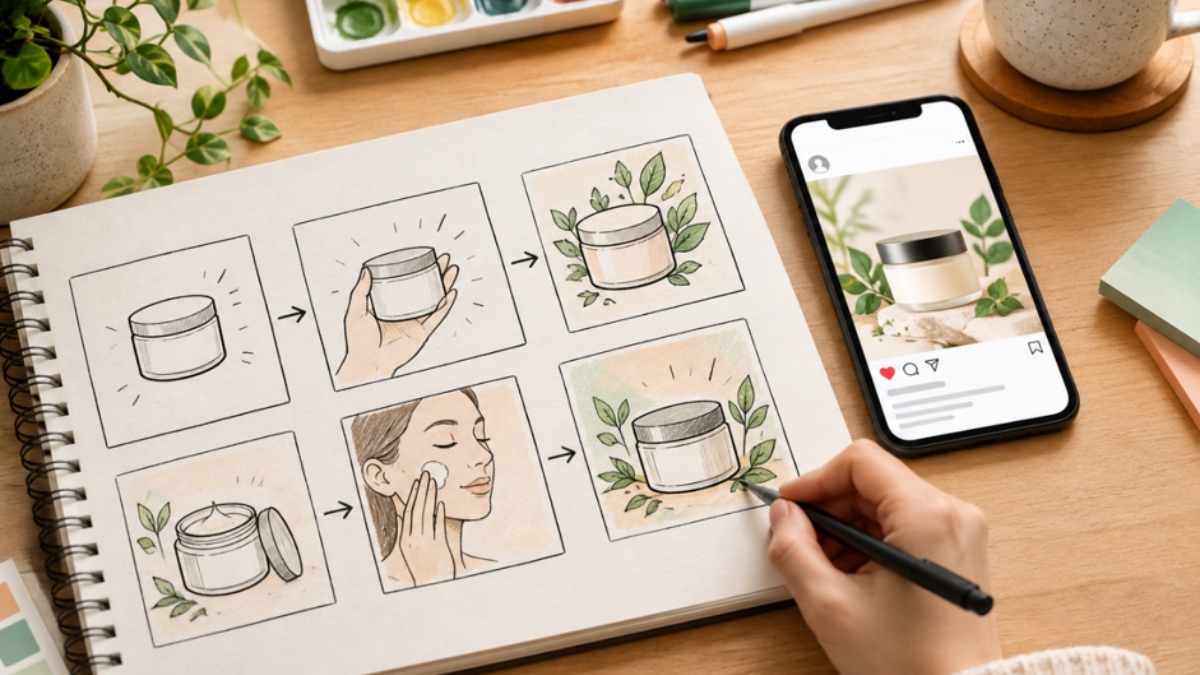
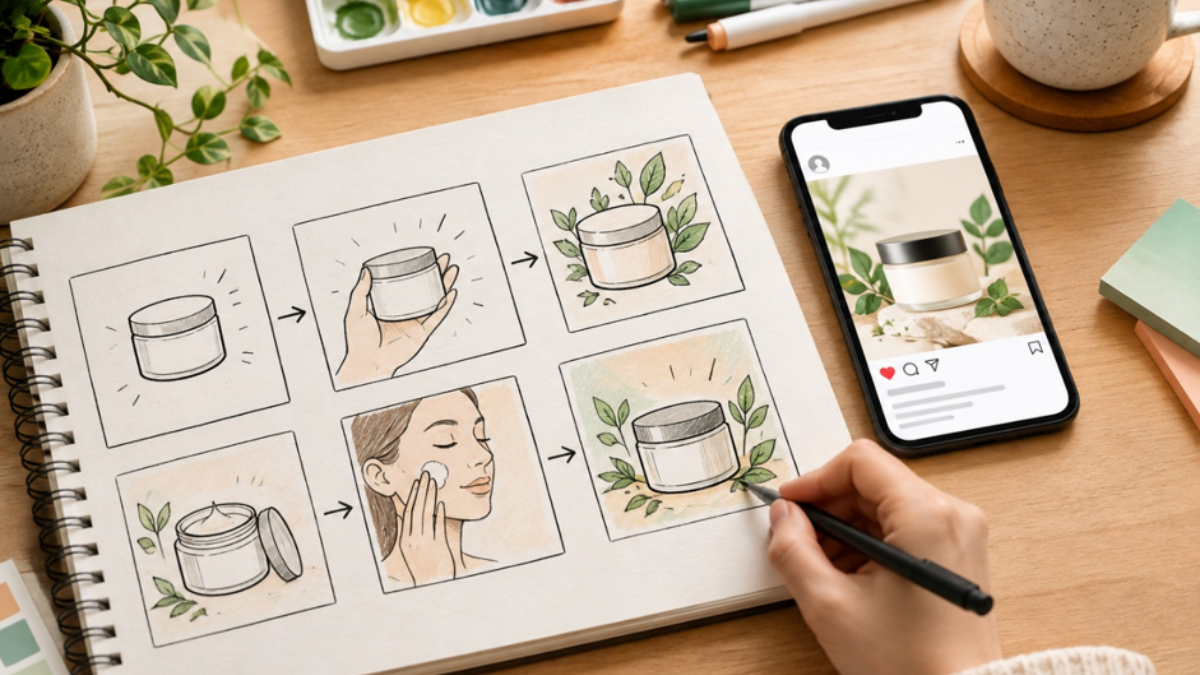
To create a hand-drawn product video for social media, define one clear message, storyboard 3 to 5 sketches (problem → product → result), photograph each stage from the same angle, animate the photos line by line, and export in the right format, such as 9:16 at 15 to 30 seconds for Reels, TikTok, and Shorts. End on the finished product with one clear call to action.
Product imagery on social media looks increasingly alike, so a video built from a sketch stands out. Watching a rough drawing evolve into the final product captures attention, builds credibility, and shows human effort, without needing a studio.
This guide covers how to plan, sketch, animate, and distribute your hand-drawn product story for brands, manufacturers, and small businesses.
Key Points
- Hand-drawn videos stand out by showing the process, not just the result.
- Tell one story: problem, product, result.
- Use 3 to 5 sketches with a constant camera angle and lighting.
- Use 9:16 for Reels, TikTok, and Shorts (15 to 30 seconds).
- End on the finished product with one clear call to action.
Why Do Hand-Drawn Product Videos Stand Out?
Generic visual product shots always feature generic backdrops, uniform lighting, and typical camera angles. The handmade product video is a deviation from that norm as it is not just the finished product that is seen but the process of its creation too.
Videos drawn by hand also make complex concepts more easily understandable. Through illustrations, certain parts can be emphasized, show how things work, or bring out some design aspect that cannot be shown through photos. The viewers will have to go through the picture bit by bit, making them watch through.
What Makes a Strong Product Story?
Product storytelling is not a list of features. It has a straightforward structure that a viewer understands in seconds.
The Three-Part Story Structure
| Story Beat | What It Shows |
|---|---|
| The problem | The everyday frustration your product addresses |
| The product | The solution, drawn into the scene |
| The result | How the customer's situation improves |
Keep the Story About One Thing
One consistent message backed by visual storytelling is more compelling than many competing messages. If an element does not relate to the main message, leave it out.
What Should You Prepare Before You Start Drawing?
Preparation keeps the process efficient and the footage consistent. Before you draw, have the following ready:
- A one-sentence synopsis of the story you intend to tell.
- A picture of your product, or an illustration of it for scale.
- 3 to 5 illustrations leading up to the final image.
- Constant lighting and camera setup so the video stays consistent.
- An actionable call to action, such as visiting your store or sharing your post.
How Do You Build a Hand-Drawn Product Video Step by Step?
Turning your idea into a finished drawing animation is simple when you follow a clear sequence. Work through the six steps below in order, and each stage will build naturally on the one before it.
Step 1: Define the message
Decide what you want your audience to keep in mind and put it into one sentence.
Step 2: Storyboard the sequence
Create three to five fundamental drawings based on the sequence of problem, solution, and consequence.
Step 3: Draw and capture each stage
After finishing all the primary stages, you should take a photograph of your work using the same camera angles for all stages.
Step 4: Animate the stages
Upload the pictures to drawing animation software that re-creates the picture line by line instead of dissolving one image into another.
Step 5: Set the pacing
Speed up with the initial drawings and make sure that the final drawing stays on the screen long enough for people to comprehend it.
Step 6: Add text, sound, and a call to action
Include a brief caption, some subtle sound effects, and a final prompt on what the viewer should do next.
Which Format and Length Suit Each Platform?
Export the video in the format that matches where it will be viewed. Vertical 9:16 suits Reels, TikTok, and Shorts, while the feed and website placements use different ratios and lengths, as shown below.
| Platform / Placement | Aspect Ratio | Recommended Length |
|---|---|---|
| Instagram Reels, TikTok, YouTube Shorts | 9:16 (vertical) | 15 to 30 seconds |
| Instagram feed | 4:5 (portrait) | 15 to 45 seconds |
| Website and product pages | Square or landscape | 30 to 60 seconds |
Place crucial information in the middle of the screen, since captions and buttons usually cover the edges. Platform requirements change, so check the latest specifications before publishing.
Can One Drawing Power an Entire Campaign?
Yes. A single illustration session can be the basis for all your content.
- Cut the recording into a short product Reel.
- Expand it into a longer web clip.
- Break it into photos for a carousel and Stories.
Reusing the same illustrations keeps your branding consistent and saves production time.
Build a Recognizable Series
Consider creating a collection, such as one product per week in a comparable style. Consistent coloring, stroke weight, and layouts help people recognize your content instantly.
Want the Story to Land? Try These Tips
A good drawing alone does not make a good product story. How you open, what you show, and how you close keep viewers watching. These tips help your message land fast, even with the sound off.
- Open with the problem or the blank page, not the logo.
- Keep the background simple so the drawing remains the focus.
- Show at least one imperfect stage to reinforce authenticity.
- Use large, readable text for viewers who watch without sound.
- End on a still frame of the finished product with a clear call to action.
Think about what makes you stop scrolling: a real problem, a drawing taking shape, and a clear ending. Your viewers react the same way, so make every second count.
Where Do Most Product Videos Go Wrong?
Most product videos fail because of small mistakes, not weak drawing. Here are the most common ones and why they hurt.
| Common Mistake | Why It Hurts |
|---|---|
| Packing multiple messages into one short video | Dilutes the core message |
| Rushing the pacing | Stages pass too quickly to register |
| Changing camera angle or lighting between stages | Breaks visual consistency |
| Hiding the product until the final second | Viewers lose the connection to the solution |
| Exporting in the wrong aspect ratio | Causes cropping or black bars |
Each of these is easy to fix before you publish. Review your video against this list once, and your story will be clearer and more consistent.
Expert Insights
Beyond the steps and checklists, a few principles consistently separate memorable product videos from forgettable ones. Keep these in mind as you plan, draw, and publish your own story.
- Clarity beats complexity. Simple diagrams usually outperform complicated ones. The message matters far more than precision or perfection.
- Imperfection builds trust. Showing a rough or unfinished stage signals authenticity and keeps viewers watching.
- Process is the hook. Watching a drawing come together line by line holds attention in a way a static product photo does not.
- Design for silent viewing. Large, readable text ensures your message lands even with the sound off.
- Repurpose, don't redo. One recorded session can be reshaped into Reels, web clips, carousels, and Stories.
Conclusion
A hand-made product story works because it combines two key elements: clarity as well as personality. A clear message, a problem-to-result structure, and appropriate pacing are usually enough to turn an average product into something people want to watch to the end. The same video can then be reused across all your channels.
With TimelapsePhoto.art, you can create a drawing animation from your process photos in just a few minutes, with no editing skills required, right in your browser. Upload your stages and publish your product story in motion.
FAQs
1. How long should a hand-drawn product video be?
Most perform well at 15 to 45 seconds on social media. A website version can run slightly longer if the product needs more explaining.
2. Do I need advanced drawing skills to make one?
No. Simple diagrams are usually more successful than complicated ones. The message matters much more than precision and perfection.
3. How many drawing stages do I need?
Three to five stages are enough to show development, from a rough draft to the final version.
4. Can I use a hand-drawn video for paid advertising?
Yes. The same video can be used organically and in paid placements, as long as it complies with each platform's requirements.
5. What should the video end with?
A snapshot of the end result and one call to action, such as visiting your store, saving the post, or following your page.
Ready to Bring Your Product to Life?
Upload a few steps of your creation process and make an impressive hand-drawn video about your product in just a couple of minutes.